
Guide
FACEIT Elo and levels explained, including levels 11 to 20
The Elo ranges behind FACEIT levels 1–10, why level 10 covers so many players, and how the extended levels 11–20 are calculated.

What Elo is on FACEIT
FACEIT Elo maps to levels 1 to 10, and FACEIT Extender splits the wide level 10 into extended levels 11 to 20 in bands of about 235 Elo, with level 15 starting at 3,001.
FACEIT ranks players in CS2 with an Elo number. You gain Elo for a win and lose it for a loss. The amount depends on the Elo of the two teams: beating a stronger team pays more than beating a weaker one, and losing to a weaker team costs more. A typical match moves your Elo by a couple of dozen points.
Because the change depends on the result, not on how many kills you got, Elo measures one thing: how often you win against players of a given strength. That is why a player with modest personal stats can still climb if their team keeps winning, and why stats and Elo are worth reading together.
Levels 1 to 10
FACEIT groups Elo into ten skill levels. These are the ranges the extension uses to read a level from an Elo number:
| Level | Elo |
|---|---|
| Level 1 | up to 500 |
| Level 2 | 501 - 750 |
| Level 3 | 751 - 900 |
| Level 4 | 901 - 1,050 |
| Level 5 | 1,051 - 1,200 |
| Level 6 | 1,201 - 1,350 |
| Level 7 | 1,351 - 1,530 |
| Level 8 | 1,531 - 1,750 |
| Level 9 | 1,751 - 2,000 |
| Level 10 | 2,001+ |
FACEIT sets these ranges and can change them. If FACEIT shows a different level than the table for a given Elo, FACEIT’s own badge is the one that counts.
Why level 10 tells you so little
Levels 1 to 9 are each a few hundred Elo wide. Level 10 has no upper limit. A player who just reached 2,001 and a player at 3,500 wear the same badge, even though the gap between them is larger than the gap between level 3 and level 9.
For anyone playing at that level, the badge stops being informative. You have to open the profile to see the actual Elo, and in a match room with ten players that is slow.
Extended levels 11 to 20
FACEIT Extender splits the top of the ladder into ten more levels. They start at 2,151 Elo and each band is 235 Elo wide, except level 14, which ends at 3,000 so that level 15 starts at 3,001. Level 20 is open-ended:
| Level | Elo |
|---|---|
| Level 11 | 2,151 - 2,385 |
| Level 12 | 2,386 - 2,620 |
| Level 13 | 2,621 - 2,855 |
| Level 14 | 2,856 - 3,000 |
| Level 15 | 3,001 - 3,235 |
| Level 16 | 3,236 - 3,470 |
| Level 17 | 3,471 - 3,705 |
| Level 18 | 3,706 - 3,940 |
| Level 19 | 3,941 - 4,175 |
| Level 20 | 4,176+ |
Players between 2,001 and 2,150 stay at level 10. These extended levels are calculated by the extension from the player’s current Elo. They are not an official FACEIT rank, and other players only see them if they use the extension too.
The badges appear in match rooms, lobbies, profiles and on party cards. The levels section of the features page shows every badge, and the guide to level badges covers the different badge styles.
Using levels well
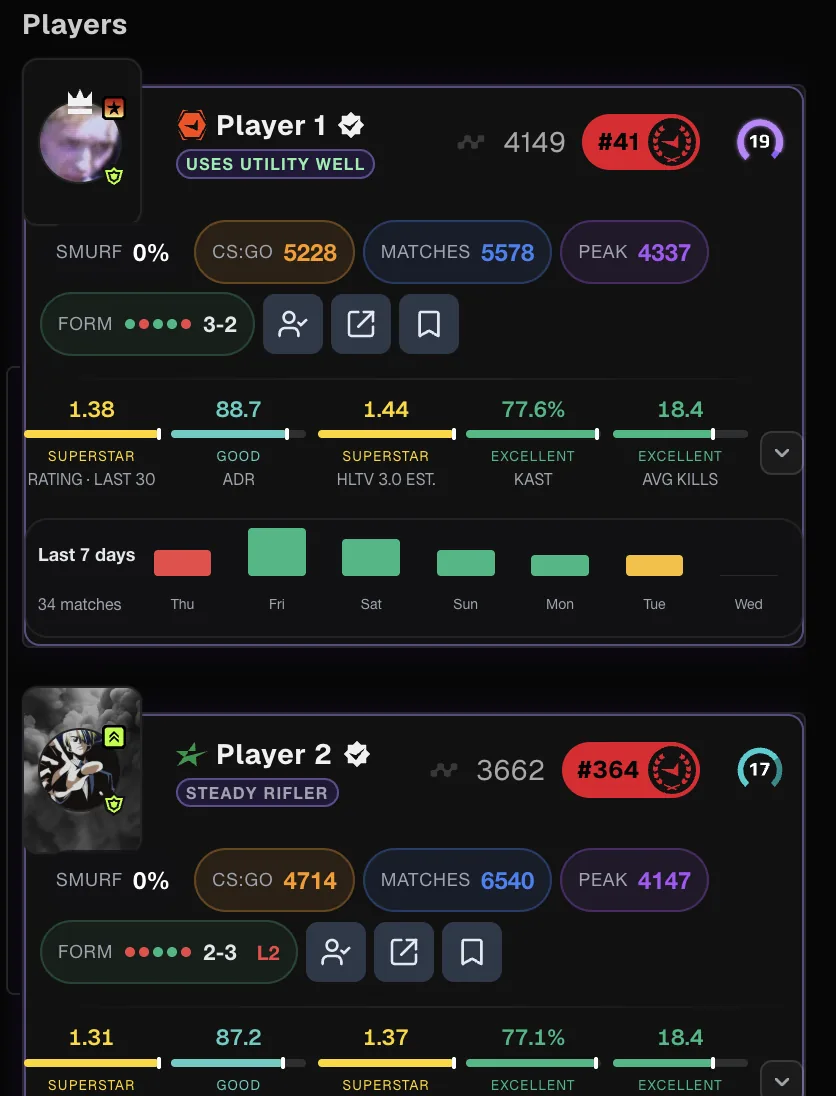
- Use the level for a quick read of the lobby, and the Elo when two players are close.
- Average team Elo predicts more than the single highest player.
- A low-level account that plays far above its level is worth a second look; the smurf guide explains what to check.
After you install the extension, extended levels are switched on by every preset from Minimal upwards, or individually in the Appearance tab of the popup. Switch them off there if you prefer FACEIT’s own badges.
Related guides
FACEIT Extender is free for Chrome and Firefox: download it or read what it is and does.
Comments
Comments load in your browser.